Bimodal Sensors for oxidative stress biomarker detection, using Electrochemistry and Mass Spectrometry on Si-graphene and Carbon based nanoneedles
PN-IV-P8-8.3-PM-RO-FR-2025-0245 (15BMFR / 01.07.2026)
Project summary
Identification of biomolecules using eco-friendly, cost-effective nanomaterials for sensing, for real-time monitoring, in biological media, with improved sensibility/selectivity, complementarity, miniaturization, portability, multiplexing, reduced analysis time/costs, expanded application range, automation of sample preparation/analysis, are requirements of nowadays scientific and industrial worlds. Together with society, it’s expected from the (bio)sensing to perform in diverse sample matrix. Creating surfaces based on nanomaterials that only apply for one analytical technique is starting to become obsolete. EC-SALDI-MS project proposal opens the gate to filling the gap between these societal expectations and technology, by combining Surface Assisted Laser Desorption Ionization Mass Spectrometry (SALDI-MS) with Electrochemistry (EC) for creating a new sensing platform using silicon nanoneedles and/or carbon-based nanomaterials/nanoneedles, for detection of oxidative stress biomarkers in plant related samples. Even though EC sensors are cost effective, rapid, precise and selective to detect biomolecules in a biological matrix, the oxidation/reduction products mechanism cannot be exactly explained or determined with this single technique. EC-SALDI-MS is a suitable analytical tool especially when it is difficult to elucidate the redox chemical reactions (e.g. biomarkers of reactive oxygen species - ROS, such as malondialdehyde - MDA), to identify some products/by-products (e.g. malondialdehyde vs. malonic acid) and their interfering species.
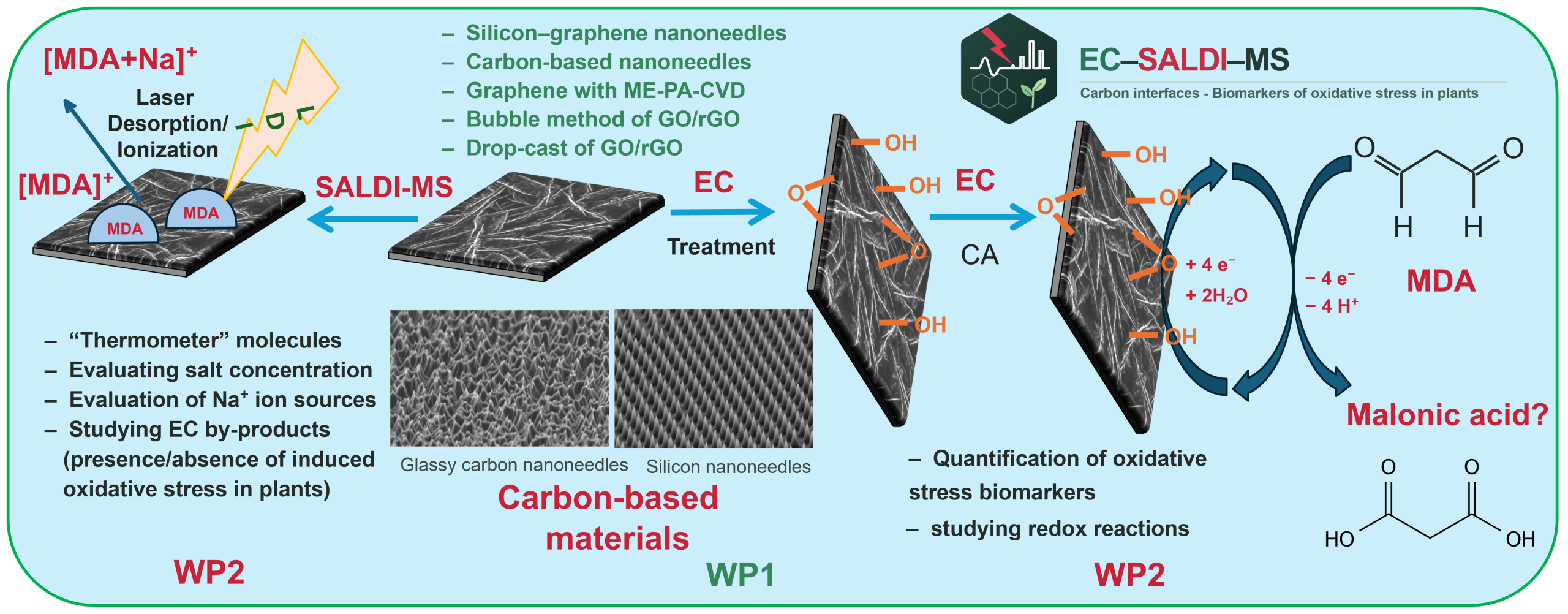
The project’s scope:
Reactive Oxygen Species (ROS, such as hydrogen peroxide, peroxynitrite, etc.) are one of the most oxidant molecules in living organisms and are highly reactive with biomolecules encountered in their vicinity. ROS create irreversible damage to proteins, DNA and lipids such as polyunsaturated fatty (PUFAs). ROS are involved in Programmed Cell Death mechanism, aging, cancer and many other diseases (both for humans and for plants). They act like redox signaling molecules or toxic molecules (depending on their concentration) including in the absence/presence of stress factors in plants (both abiotic and biotic stress). The EC-SALDI-MS (carbon interfaces for oxidative stress biomarkers in plants) proposes to create a new sensing platform for detections of oxidative stress biomarkers, using either carbon based or silicon based nanoneedles with graphene coatings, in relevant plant extracts/plant tissues. The world-wide situation in which food demand is increasing (80% is plant-based), especially in negative climate changes, is in contrast with actual nowadays 40% crop loss (according to FAO). The solution requires Precise Agriculture (PA), based on wearable/implantable plant sensors and EC-SALDI-MS concept is the first step in reaching this solution.
Contracting authority: Executive Unit for Financing Higher Education, Research, Development and Innovation (UEFISCDI)
Implementation period: 01/07/2026-31/12/2027
Total budget: 37.436 lei
Project director: Dr. Chem. Ioana Silvia Hosu

National Institute for Research & Development in Chemistry and Petrochemistry – ICECHIM Bucharest
Institute of Electronics, Microelectronics and Nanotechnology (IEMN) - Villeneuve-d'Ascq, France.
- Dr. Chem. Ioana Silvia Hosu, Scientific Researcher II (Senior Researcher), Post-Doc and Project Director, Brainmap ID: U-1700-039M-4191.
- Iulia Elena Neblea, Scientific Researcher (PhD student), Brainmap ID: U-2000-066L-0880.
- Mădălina Oprică, Scientific Researcher (PhD student), Brainmap ID: U-1900-064G-1227.
- Cătălina-Diana Ușurelu, Scientific Researcher (PhD Student), Brainmap ID: U-2100-067Q-6519.
Development of carbon/silicon surfaces + characterization with EC-SALDI-MS
A.1.1. Creating different carbon/silicon-based surfaces.
A.1.2. Evaluating the developed surfaces using SALDI-MS.
A.1.3. Evaluating the best surfaces for SALDI-MS using EC.
Testing + validating developed surfaces for oxidative stress biomarkers
A.2.1. Quantification with EC.
A.2.2. Studying by-products with MS in absence/presence of induced oxidative stress.
A.2.4. Characterization of functional surfaces.
- Under construction
- Under construction
From the cognitive and socio-economic perspectives, the EC-SALDI-MS project holds potential impact for Precision Agriculture (PA), as the developed methodology can be further utilized for the monitorization of plant health in real time, the efficacy study of plant treatments, the redox signaling study, and other agricultural applications. The application of such sensors is not limited to precision agriculture; they can also be adapted into wearable sensors for other living organisms (such as humans or animals) to detect the same oxidative stress biomarkers—which affect all living organisms. The use of functionalized nanoneedles represents a significant step toward implantable nanosensors for real-time plant health monitoring, a crucial element of sustainable precision agriculture. These structures enable the non-invasive in situ or in vivo identification and characterization (fingerprinting) of metabolites, oxidized lipids, and signaling molecules directly from living tissues.
