INNOVATIVE MXENE-PEPTIDES FOR ELECTROCHEMICAL
MINIATURIZED PLATFORMS DEDICATED TO TUMOR BIOMARKER DETECTION
PN-IV-P2-2.1-TE-2023-1281
MXEPEPMIN
Project Summary
The project MXEPEPMIN proposes the development of miniaturized electrochemical biosensors for fast, sensitive and selective detection of the lung cancer biomarkers, carcinoembryonic antigen (CEA) and epidermal growth factor receptor (EGFR), using novel functionalized MXene nanomaterials and peptides as bioreceptors. The functionalized MXenes provide a conductive layer which enhances the sensitivity of the electrochemical detection, and represent the support for the covalent binding of the receptor peptides. The resulting MXene-Peptide biosensors will display higher sensitivity and specificity, a better reproducibility and stability compared to traditional methods for early detection of lung cancer biomarker. The specific objectives of the project are: 1) the preparation of functionalized MXene with enhanced electrochemical properties; 2) the development of sensitive and selective MXene-Peptide electrochemical biosensors; 3) the integration of the MXene-Peptide biosensors in miniaturized devices for the non-invasive detection of CEA and EGFR in human saliva. This project will have an impact in the field of clinical applications for early-stage diagnosis and treatment of lung cancer.
General Data of the Project
Institution: UEFISCDI – Executive Agency for Higher
Education, Research, Development and Innovation Funding
Period: 03/01/2025 – 31/12/2026
Budget: 500.000 lei / 100.000 Euro
Members of the MXEPEPMIN project research team:
- CSIII dr. Lucian Gabriel Zamfir
- CSIII dr. Mariana Constantin
- CSI dr Ana-Maria Gurban
- CSIII dr. Ioana Cătălina Gîfu
- CS Cristina Firincă
- CS dr. Anda Maria Baroi
- CS dr. Bogdan Trică
MXEPEPMIN Project Objectives
The specific project objectives for the first stage in 2025 are:
1) Development of modified MXene-based interfaces for peptide immobilization;
2) Development of modified electrochemical biosensors for CEA and EGFR detection;
Obiectivele proiectului MXEPEPMIN
Obiectivele specifice ale proiectului pentru prima etapă din 2025 sunt:
1) Realizarea de interfețe pe bază de MXene modificată pentru imobilizarea peptidelor;
2) Realizarea de biosenzori electrochimici modificați pentru detecția CEA și EGFR;
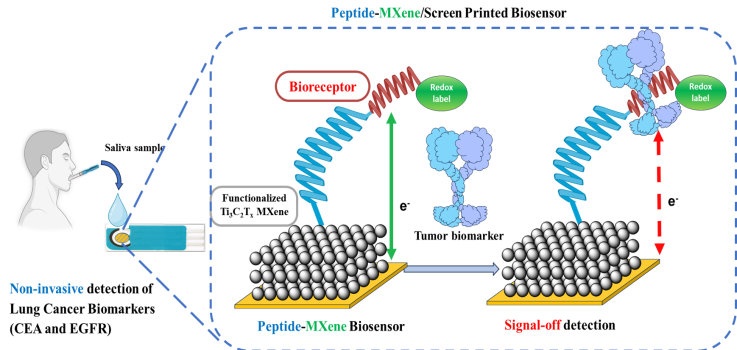
Project Stages
1 – Design and development of Mxene-based sensors; Design and development of Mxene-peptide biosensors
Period: 03.01.2025 – 31.12.2025
Activities carried out:
• Synthesis and characterization of MXene functionalized with amino groups
• Modification of the electrochemical sensor with the MXene-based layer
• Electrochemical characterization of the modified sensors
• Surface imaging characterization of the modified sensors
• Optimization of the surface modification process
• Testing the antimicrobial properties of MXene-based nanomaterials
• Modification of the functionalized electrode surface with crosslinking reagents
• Immobilization of the receptor peptide on the surface of the modified sensors
• Electrochemical characterization of the modified biosensors
• Surface imaging characterization of the modified biosensors
• Optimization of the modification protocol to increase the coverage and stability of the bioreceptor surface
• Management and dissemination of results
2 – Demonstration of the functionality of peptide-Mxene-based biosensors for the detection of tumor biomarkers CEA and EGFR
Period of implementation: 01.01.2026 – 31.12.2026
Activities carried out:
• Modification of the functionalized electrode surface with cross-linking reagents (activity completion)
• Immobilization of the receptor peptide on the surface of the modified sensors (activity completion)
• Electrochemical characterization of the modified biosensors (activity completion)
• Optimization of the modification protocol to increase surface coverage and stability (activity completion)
• Establishment of the protocol for electrochemical biosensor analysis
• Detection of tumor biomarkers using electrochemical techniques
• Optimization of electrochemical detection conditions
• Regeneration of the biosensor surface; studies on the stability and reproducibility of biosensors
• Study of potential interfering compounds in the sample
• Detection of analytes in real biological samples
• Validation of the detection method using HPLC and ELISA techniques
• Management and dissemination of results
Publications
• Wearable multisensing patch based on SWCNT-PtNPs nanocomposites for clinical biomarkers monitoring from sweat, Lucian-Gabriel Zamfir, Saniye Soylemez, Dilek Soyler, Dilara Yeniterzi, Petru Epure, Cătălina Gîfu, Iuliana Răut, Mariana Constantin, Cristina Firincă, Nicoleta-Olguța Corneli, Maria-Luiza Jecu, Mihaela Doni și Ana-Maria Gurban, to be sent to Polymers journal
Intenational scientific conferences
• 4th International Conference on Advanced Materials ICAM 2025, Jordan University of Science and Technology, 20 – 24 May 2025, Irbid, Jordan, Advanced nanomaterial-based biosensors for quality assesment in food safety, environmental health and clinical diagnosis, – Oral Presentation
• 8th International Conference on Emerging Technologies in Materials Engineering EmergeMAT, IMNR, 06 – 07 Octomber 2025, București, Romania – Functional conductive MXenes as supports for bioreceptor immobilization in biosensing applications, Zamfir L.-G., Gîfu C., Răut I., Constantin M., Firincă C., Jecu L., Alexandrescu E., Doni M., Gurban A.-M. – Poster
• 22nd edition of the International Exhibition of Scientific Research, Innovation, and Invention – PRO INVENT 2025, 15 – 17 Octomber 2025, Cluj-Napoca, Romania – Innovative MXene-peptides for electrochemical miniaturized platforms dedicated to tumor biomarker detection, Zamfir L.-G., Gîfu C., Răut I., Constantin M., Firincă C., Jecu L., Doni M., Gurban A.-M. – Poster
• ”Priorities of Chemistry For A Sustainable Development” PRIOCHEM – XXI, 15-17 Octomber 2025, Bucharest, Romania, Biosensing platforms with advanced nanocomposites for non-invasive monitoring of biomarkers in biological fluids, Zamfir L.-G., C. Gîfu, Soylemez S., Soyler D., Epure P., Răut I., M. Constantin, Firincă C., Jecu M.-L., Doni M., Gurban A.-M. – Poster
Prizes:
• XXII edition of International PRO INVENT Exhibition – PRO INVENT, 15-17 Octombrer 2025, Cluj-Napoca, Romania, Diplomă de excelență și Medalia de aur PRO INVENT, MXene-peptide inovative pentru platforme electrochimice miniaturizate dedicate detecției de markeri tumorali, Zamfir L.-G., Gîfu C., Răut I., Constantin M., Firincă C., Jecu L., M. Doni, Gurban A.-M.
• 17th European Exhibition of Creativity and Innovation – EUROINVENT, 8-10 Mai 2025, Iași, Romania, Medalie de aur EUROINVENT, Innovative MXene-Peptides for Electrochemical Miniaturized Platforms Dedicated to Tumor Biomarker Detection Zamfir L.-G., Gurban A.-M. , M. Doni, Gîfu C., Firincă C., Constantin M., Baroi A.M.
• Ediția XXII Salonul Internațional al Cercetării Științifice, Inovării și inventicii – PRO INVENT, 15-17 Octombrie 2025, Cluj-Napoca, Romania, Certificate of Appreciation – Asociația Justin Capră, MXene-peptide inovative pentru platforme electrochimice miniaturizate dedicate detecției de markeri tumorali, Zamfir L.-G., Gîfu C., Răut I., Constantin M., Firincă C., Jecu L., Doni M., Gurban A.-M.
• Ediția XXII Salonul Internațional al Cercetării Științifice, Inovării și inventicii – PRO INVENT, 15-17 Octombrie 2025, Cluj-Napoca, Romania, Certificate of Excelence – Research & Development Center Healthy vibe, MXene-peptide inovative pentru platforme electrochimice miniaturizate dedicate detecției de markeri tumorali, Zamfir L.-G., Gîfu C., Răut I., Constantin M., Firincă C., Jecu L., Doni M., Gurban A.-M.
Publications
• Wearable multisensing patch based on SWCNT-PtNPs nanocomposites for clinical biomarkers monitoring from sweat, Lucian-Gabriel Zamfir, Saniye Soylemez, Dilek Soyler, Dilara Yeniterzi, Petru Epure, Cătălina Gîfu, Iuliana Răut, Mariana Constantin, Cristina Firincă, Nicoleta-Olguța Corneli, Maria-Luiza Jecu, Mihaela Doni și Ana-Maria Gurban, to be sent to Polymers journal
The impact of the MXEPEPMIN project:
1) The estimated scientific results
The main goal of MXEPEPMIN is to develop modified interfaces that combines the properties of novel 2D- inorganic compounds with those of synthetic peptides as specific biorecognition elements. The main results of the project will be the innovative and miniaturized Peptides-MXene based bioanalytical tools for early detection of CEA and EGFR biomarkers that will be obtained. The developed biosensors are expected to display enhanced sensitivity, selectivity, antifouling and antimicrobial properties, as well as good reproducibility and detection of biomarkers in low sample volume. The proposed biosensors will be the basis for the development of a new detection methods for the CEA and EGFR lung cancer biomarkers at concentration values of pg/mL. The estimated results for the whole project are: 3 papers published in ISI Web of Science indexed international journals; the presentation of the results at least 6 scientific conferences; and 1 patent application.
2) The potential impact of the project on the host institution and the project team
The project will contribute to the visibility of the research teams from the host institution on an international scale by reporting the result in ISI WoS indexed international publications and presenting the results at scientific conferences and symposiums. The project leader and the research team members will gain experience in project management and multidisciplinary research as the team members have different fields of research, and will exchange scientific knowledge with each other and can help them have a more comprehensive view of scientific research for further projects. The project will contribute to the training of young scientists, in a prestigious research institution within Romania.
3) The impact over the scientific, technological, social, economic or cultural environment
The proposed method will lead to the development of new point-of-care sensing devices for biomarker detection and will represent an important scientific impact in the field of clinical applications. The MXene-peptides based biosensors will facilitate the sensitive, selective, fast and low-cost detection of lung cancer tumors. The developed detection format within this project could also be further adapted to other types of analytes by replacing the receptor peptide with one specific for other types of tumor biomarkers, or markers for other clinical conditions such as diabetes, inflammation or infections. Thus, the project will have a positive impact in the field of clinical applications and lead to further innovations that will improve early-stage detection and treatment of lung cancer and thus contribute to the improvement of human health.