COFUND-WATER4ALL-WATER-BIOFIL-1
“Next-generation biodegradable filters for
water purification and desalination”
Domain: 3- Food, bioeconomy, natural resources, biodiversity, agriculture and environment (ASC); Bioeconomy (DSIN); Environment and Eco-technologies (DSIN)
Project Coordinator:

CS I. Dr. Eng. Tanta-Verona IORDACHE, National Research & Development Institute for Chemistry and Petrochemistry ICECHIM, Bucharest, Romania Advanced Polymer Materials and Polymer Recycling Group ()
Project Partners:


Prof. Dr. Eng. Francois-Xavier PERRIN,
University of Toulon, Lab. MAPIEM, La Garde, France ()

CS III. Dr. Bioch. Andreea Gabriela
OLARU,
Director of the R&D Dept.
and Quality Dept., S.C.
EDAS-EXIM S.R.L., Bucharest, Romania
().


National Funding Agencies
Unitatea executiva pentru finantarea invatamantului superior, a cercetarii, dezvoltarii si inovarii UEFISCDI
UEFISCDI and CE: 180.000 € (ICECHIM) + 70.000 € (EDAS-EXIM)
Co-financing amount from EDAS-EXIM: 33.500 €
Agence Nationale de la Recherche - ANR
ANR and CE: 60149 € (Marine Tech) + 202496 € (MAPIEM)
Co-financing amount from Marine Tech 73516 € and 89727 € from MAPIEM
Narodowe Centrum Badań i Rozwoju - NCBR
NCBR and CE: 63750 € (PRESSEKO) + 125750 € (AMU)
Co-financing amount from PRESSEKO 15937,5 €.
Duration of project: 36 months (start date: 01 April 2024)
Project Summary
Water is the most abundant and indispensable resource of our planet. However, freshwater distribution is very different from region to region, which brings with it a very problematic scenario for drinking water availability, especially following hydro-climatic extreme events. One viable and low-cost solution to provide direct access to drinking water, refers to implementing Point-Of-Use (POU) systems for water purification and desalination. Yet, before doing so, the issues identified by
end-users/ consumers regarding filters disposal and recycling should be properly addressed. Thereby, the aim of the WATER-BIOFIL project proposal is to design & assemble & test next generation compostable filters, prepared from biodegradable polymers and/or bio-sourced polymers, which can be thereafter integrated in regular POU systems, and further serve their purpose as first-aid tools to cope with hydro-climatic extreme events, while diminishing the environmental impact of hazardous materials. Considering the proposed aim of the project and the transdisciplinary character of the foreseen activities, the project consortium is joining three renowned RDI entities, from Romania, France and Poland, with expertise in materials science and functional biomaterials (as technology developers), and other three SMEs from Romania, France and Poland (as technology integrators), with expertise on water purification and waste management. The six Partners are developing complementary activities according to their expertise and skills to ensure
further development and/or build-up a multidisciplinary knowledge in a long-term perspective innovation, value creation and assistance in solving societal challenges. The project proposal addresses the required Polish, French, Romanian and EU impacts, with respect to the objectives of WATER4ALL, on ensuring water security for all and reducing environmental hazards.
Project aim
The aim of WATER-BIOFIL refers to design & assembly & testing of next generation filters, prepared from biodegradable polymers and/or bio-sourced polymers, which can be thereafter integrated in regular POU systems, and further serve their purpose as first-aid tools to cope with hydro-climatic extreme events, while diminishing the environmental impact of hazardous materials.
Estimated Results of the Consortium:
R1. Biodegradable filler materials, for retaining metal ion traces, dyes, organic residues, and salt ions as carried out by the RDI Partners of the project.
R2. Biodegradable cartridge prototypes that are easy to integrate in the production line of filters manufacturers for water purification, as carried out by the RDI Partners of the project with the guidance of SME Partners and External Advisors.
R3. End-of-use strategies applicable to the next generation filters, with the help and support of Polish SME Partner in the field of waste management.
R4. Feasibility study for the potential/ future market release of the next generation filters, with the help and support of the Romanian and French SME Partners in the field of water desalination and wastewater management.
R5. Short-term scenario of outcomes: (i) 7 ISI Open Access publications (at least two in collaboration) in journals of prestige from the Royal Society of Chemistry (RSC), Wiley, MDPI, Springer and Elsevier; (ii) 7 International communications to specific Symposia & Conferences, (iii) participation to 1 Invention Salon, and (iv) 3 Round Tables and/or Workshops with the organizer/ participant status.
Acknowledgement:
Project Partners would like to thank the European Commission and [UEFISCDI, ANR and NCBR] for funding in the frame of the collaborative international consortium [WATER-BIOFIL] financed under the 2022 Joint call of the European Partnership 101060874 — Water4All.


PHASE I. Obtaining the biopolymer as a raw material for the manufacture of hybrid biomaterials and the formulations for PLA-based composite as a material for the manufacture of filter cartridges
PERIOD: 01.04.2024-31.12.2024
OBJECTIVES
Activity 1.1 Preparation of the biopolymer, for its use by the Project Partners, as a raw material for obtaining functional hybrid biomaterials of TYPE I and TYPE II
Activity 1.2 Establishment of procedures for collecting drinking water for testing biomaterials
Activity 1.3 Development of experimental formulations based on PLA that are suitable for melt processing
Activity 1.4 Establishment of the filter cartridge model compatible with POU systems and the specific design characteristics
Activity 1.5 Dissemination and communication of the results
SUMMARY
In the first stage of the project, a chitosan type was obtained from commercial chitin with reproducible properties (degree of deacetylation and molecular weight). This chitosan type was transmitted to the project partners for obtaining functional hybrid biomaterials of TYPE I and TYPE II. Also within this activity, the ability of the chitosan to be used in various formulations of hybrid materials, with zeolite content, for the retention of metal ions, nitrites, nitrates, etc., from drinking water was tested. The testing of biomaterials for the retention of contaminants in drinking water was carried out by the SME partner and resulted in a major decrease in the concentration of iron and aluminum ions. For these determinations, the SME partner of the project proposed a water sampling procedure, as well as specific methods for the determination of pollutants of interest. In parallel, activities were carried out to obtain composite samples based on PLA, formulations that will be optimized for the development of the filter cartridge. In order to adjust the properties of interest, the PLA-based composites were analyzed from a thermal, mechanical, morphological and structural point of view. Also during this stage, a filter cartridge model compatible with POU systems was established, together with the IMM partner. Based on the dimensional and functional characteristics of the commercial cartridges used in POU systems, the specific design characteristics of the new PLA-based filter cartridge were established - design made in a CAD software.
Results: Synthesis and analysis report of chitosan from commercial chitin; Synthesis and analysis report of biopolymer composites based on chitosan; Drinking water collection procedures; Experimental formulations based on PLA, Preparation and analysis report of experimental formulations based on PLA; Technological design proposal; Dissemination and travel report;
During phase 1/2024, a project kick-off meeting was organized with the online participation of the project partners (in May) and a follow-up meeting with the partial, physical participation of the partners from France (Univ. Toulon MAPIEM) and Poland (Univ Adam Mickiewicz), in October in Bucharest, Romania, with the ocazion of PRIOCHEM XX Symposium.
The WATER-BIOFIL project website was built and updated, both in English (https://icechim.ro/project/waterbiofil-en/) and in Romanian language (https://icechim.ro/project/waterbiofil-ro/).
The Project Director participated in the WATER4ALL project kick-off meeting (kick-off of the cofunded call 2022, April 2024 in Madrid, Spain), organized by the coordinator of this call (AEI, Spain).
An original article and a review were published (both in WoS indexed journals) and 5 scientific communications were held (of which 3 oral presentations), as follows:
1. Sandu, T.; Olaru, E.A.; Mitran, R.-A.; Miron, A.; Dolana, S.-V.; Zaharia, A.; Gavrilă, A.-M.; Dumitru, M.-V.; Chiriac, A.-L.; Sârbu, A.; Iordache, T.-V. Composite Copolymer Beads Incorporating Red Mud for Water Amendment by Adsorption—Oxidation Processes. Appl. Sci. 2024, 14, 6386. https://doi.org/10.3390/app14146386
2. Gavrila, A.-M.; Diacon, A.; Iordache, T.-V.; Rotariu, T.; Ionita, M.; Toader, G. Hazardous Materials from Threats to Safety: Molecularly Imprinted Polymers as Versatile Safeguarding Platforms. Polymers 2024, 16, 2699. https://doi.org/10.3390/polym16192699
Ø 23rd Romanian International Conference on Chemistry and Chemical Engineering, Constanța - Mamaia, ROMANIA - September 4 – 7, 2024. Chitosan-Based Composite Polymeric Beads: An Innovative Approach for Copper Ion Retention, Andreea Miron, Iulia-Elena Neblea, Sorin-Viorel Doalana, Marinela Dumitru, Andrei Sarbu, Horia Iovu, Ana-Mihaela Gavrila, Anamaria Zaharia, Sandu Teodor, Tanta-Verona Iordache, Anita-Laura Chiriac (oral)
Ø 23rd Romanian International Conference on Chemistry and Chemical Engineering, Constanța - Mamaia, ROMANIA - September 4 – 7, 2024. Retention of Ciprofloxacin and Carbamazepine from Aqueous Solutions using Chitosan-Based Composite Cryostructures, Marinela-Victoria Dumitru, Andreea Miron, Iulia-Elena Neblea, Sorin-Viorel Dolana, Anamaria Zaharia, Ana Mihaela Gavrila, Andrei Sarbu, Horia Iovu, Sandu Teodor, Anita-Laura Chiriac, Tanta-Verona Iordache (oral)
Ø National Conference of Chemistry, XXXVII Edition, 24-27 Septembrie, Targoviste, Romania, Carbon Electrodes Modified With Molecularly Imprinted Polymers For Lipopolysaccharides Sensing, Ana Lorena Neagu, Ana-Mihaela Gavrilă, Andreea Miron, Iulia Elena Neblea, Cătălin Zaharia, Petru Epure, Hugues Brisset, Horia Iovu, Andrei Sârbu, Tanța-Verona Iordache (P)
Ø 20th International Symposium “Priorities of Chemistry for a Sustainable Development” PRIOCHEM, Bucharest, Romania, 16-18 Oct-2024, Cryostructures As Potential Agricultural Fertilizers With Controlled Release Properties, Marinela-Victoria DUMITRU, Alin Cristian Nicolae VINTILA, Grigore PSENOVSKI, Ana-Lorena NEAGU, Sorin DOLANA, Andreea MIRON, Iulia Elena NEBLEA, Ana Mihaela GAVRILA, Cristina Emanuela ENASCUTA, Tanta-Verona IORDACHE (oral)
Ø 20th International Symposium “Priorities of Chemistry for a Sustainable Development” PRIOCHEM, Bucharest, Romania, 16-18 Oct-2024, Advanced Hybrid Materials Based On Natural Polymers: A New Remediation Strategy For Water Contaminated With Heavy Metals, Andreea MIRON , Ana-Lorena NEAGU , Sorin DOLANA, Iulia-Elena NEBLEA, Marinela Victoria DUMITRU, Anamaria ZAHARIA, Sandu TEODOR, Ana-Mihaela GAVRILĂ, Andrei SÂRBU, Anita-Laura CHIRIAC, Tanța-Verona IORDACHE (P)

STAGE II Development of experimental filter cartridges for the POU system
and their testing
PERIOD: 01.01.2025-31.12.2025
OBJECTIVES
Activity 2.1 Actual execution of the metalmolds, necessary for injection molding
Activity 2.2 Preliminary evaluation of the TYPE I hybrid biomaterials (sent by the University of Toulon)
Activity 2.3 Proposal of injection molding procedures using the prepared metal molds
Activity 2.4 Selection of experimental PLA-based formulations leading to desired physical characteristics of the filter cartridge for the POU system (shape, thermal and mechanical stability)
Activity 2.5 Individual evaluation of the TYPE I and TYPE II hybrid biomaterials, loaded as adsorbent material
in experimental filter cartridges
Activity 2.6 Protection of intellectual/industrial property
Activity 2.7 Dissemination and communication of the results
SUMMARY
In the second stage of the project, several prototypes of PLA-based filter cartridges were made and tested using 3D printing instead of injection molding, as justified in the previous stage. To this end, several PLA composite formulations were optimized and mechanically and thermally tested in order to select the most suitable preparation recipe, so that the obtained formulation could be processed both by injection (at industrial level) and by extrusion to obtain uniform filaments used in the 3D technique.
Following the selection, both injection and extrusion procedures were developed using the optimized PLA-based formulation. As part of the testing activities, the 3D printing process was also optimized, and the samples thus obtained were sent to the Polish SME partner for biodegradability testing. According to the justifications from the previous stage, the type I adsorbent was prepared by ICECHIM and tested in collaboration with EDAS but also with MAPIEM through a research internship carried out by a PhD student in the MAPIEM laboratory.
Two other series of type I adsorbent will be prepared by MAPIEM for testing, but for the next stage. Also, since the partners in Poland contracted the project 8 months late, the type II adsorbent was not produced on time by Univ. Mickiewicz for testing on the experimental cartridges; thus, type II will also be tested in the next stage. Thereby, the testing on the experimental cartridges was carried out by EDAS only for the type I adsorbent prepared by ICECHIM. The testing was carried out in two series, in a dynamic POU system, monitoring the retention of metal ions, nitrites, nitrates, etc., from drinking water.
The performances of the adsorbent material were compared with those of a commercial cartridge based on activated carbon. Unlike the static testing (Stage 1), in the first series of tests on the POU system, a decrease in nitrates was also found, as well as a significant retention of nickel from the tested waters, that in addition to iron and aluminum ions. Contrary to expectations, the adsorbent material could be reconditioned after the first testing stage (without changes in structure or morphology) and reused with quite good performance in a subsequent stage in which the reproducibility of the previous performances was monitored.
RESULTS
- Prototypes ofcartridges made by 3D printing with commercial PLA filament
- Preliminary evaluation report
- Optimization report of TYPE I adsorbents
- Operational procedures for injection molding
- Operational procedures for extrusion
- Evaluation report of physical, mechanical and thermal characteristics
- Experimental filter cartridges
- Operational procedures for the POU system
- Individual evaluation report of the performances for TYPE I hybrid biomaterials
- Patent application
- Dissemination and travel report
DISSEMINATION AND COMMUNICATION
During the project, several trips were made in the country to the headquarters of the EDAS-EXIM partner or to various conferences and innovation fairs in order to communicate and disseminate the results. Also, trips were made abroad to the headquarters of the MAPIEM partner - Univ. Toulon, France (8-week doctoral internship to carry out activities within the project) and to the AEI headquarters in Madrid, Spain, where the Project Director participated in the Mid-term Meeting of Projects WATER4ALL (November 11-12, 2025). The project partners met in several online and physical meetings, with the aim of establishing the next steps to achieve the objectives, taking into account the problems that arose during the implementation of the project.
A project progress meeting was organized with online participation (February 27, 2025) and a meeting with physical participation, in September, at MAPIEM, in Toulon, France (September 24, 2025). Concurrently with the progress meeting at MAPIEM (September 23, 2025), a workshop organized by MAPIEM and ICECHIM (Advanced Materials and Methods for Water Purification) was held, during which 8 studies representing the results obtained by all partners within the WATER-BIOFIL project were presented. The project was disseminated through several means: using LinkedIn media platforms (https://www.linkedin.com/company/incdcp-icechim/posts/), presentation at innovation fairs and the WATER-BIOFIL project website (https://icechim.ro/project/waterbiofil-en/ and https://icechim.ro/project/waterbiofil-ro/).
A review and an editorial were published (in WoS indexed journals) and 3 scientific communications were held (2 oral presentations). ICECHIM also participated in the Proinvent 2025 Innovation Show to disseminate the project's aim and objectives and filed a patent application.
1. Teodor Sandu, Anita-Laura Chiriac, Anamaria Zaharia, Tanta-Verona Iordache, Andrei Sarbu, New Trends in Preparation and Use of Hydrogels for Water Treatment, Gels 2025, 11, 238, https://www.mdpi.com/2310-2861/11/4/238
2. Anita Chiriac, A.-L.; Sarbu, A.; Zaharia, A. Editorial, Recent Advances in Gels for Water Treatment. Gels 2025, 11, 519, https://doi.org/10.3390/gels11070519
3. Marinela-Victoria DUMITRU, Ana Mihaela GAVRILA, Ana-Lorena NEAGU, Andreea MIRON, Iulia Elena NEBLEA, Sorin DOLANA, Anamaria ZAHARIA, Anita-Laura CHIRIAC, Andrei SARBU, Tanta-Verona IORDACHE, Teodor SANDU, Composite membranes based on chitosan coated with organosilane by sol-gel, 4th Coatings and Interfaces Online Conference (CIC2025), 21–23 May 2025 (P)
4. Marinela-Victoria DUMITRU, Ana Mihaela GAVRILA, Andreea MIRON, Iulia Elena NEBLEA, Anamaria ZAHARIA, Anita-Laura CHIRIAC, Andrei SARBU, Tanta-Verona IORDACHE, Teodor SANDU, Foams with semi-interpenetrated networks of chitosan and organosilicate, 4th International Conference on Bioengineering and Polymer Science (BPC), Brasov, ROMANIA - June 2-5, 2025 (OC)
5. Andreea Miron, Ana-Mihaela Gavrila, Iulia-Elena Neblea, Marinela-Victoria Dumitru, Sorin Dolana, Ana-Lorena Neagu, Teodor Sandu, Anita-Laura Chriac, Andreea Gabriela Olaru, Tanta-Verona Iordache, Next-Generation Chitosan-Based Materials for High-Efficiency Drinking Water Treatment, 4th International Conference on Bioengineering and Polymer Science, Brasov, ROMANIA - June 2-5, 2025 (OC)
6. Next-generation biodegradable filters for water purification and desalination, 22nd Edition of the International Exhibition of Research, Innovations and Inventions – PRO INVENT, 15 – 17 October 2025, Autori: Tanta-Verona Iordache, Francois Xavier Perrin, Michal Ceglowski, Andreea Olaru, Thierry Carlin, Robert Maciejewski, Adriana Nicoleta Frone.
Prizes: Diploma of Excellence and Gold Medal of the Salon. Certificate of Excellence from the Politehnica University of Timisoara
and Special Award. Certificate of Appreciation from the Justin Capra Association. Diploma and Gold Medal from the Traian Vuia Salon of Inventions and Innovations.
7. Umpluturi din Biocompozite de Chitosan cu Zeolit pentru Reţinerea Ionilor de Aluminiu si de Fier din Ape si Procedeu de Preparare a Acestora/ Chitosan-Zeolite Biocomposite Fillers for Retaining Aluminum and Iron Ions from Water and Process for Their Preparation, Authors: Iordache Tanta-Verona, Miron Andreea, Sarbu Andrei, Neblea Iulia Elena, Iordanescu Marinela Victoria, Chiriac Anita-Laura, Gavrila Ana Mihaela, Olaru Andreea Gabriela, Cosasu Dan, A00433/06.10.2025.

SUMMARY OF MIDTERM REPORT
PERIOD: 01.04.2024-30.09.2025 (18 months)
Water is the most abundant and indispensable resource of our planet. However, freshwater distribution is very different from region to region, which brings with it a very problematic scenario for drinking water availability,especially following hydro-climatic extreme events. One viable and low-cost solution to provide direct access to drinking water, refers to implementing Point-Of-Use (POU) systems for water purification and desalination. Yet, before doing so, the issues identified by end-users/ consumers regarding filters disposal and recycling should be properly addressed.
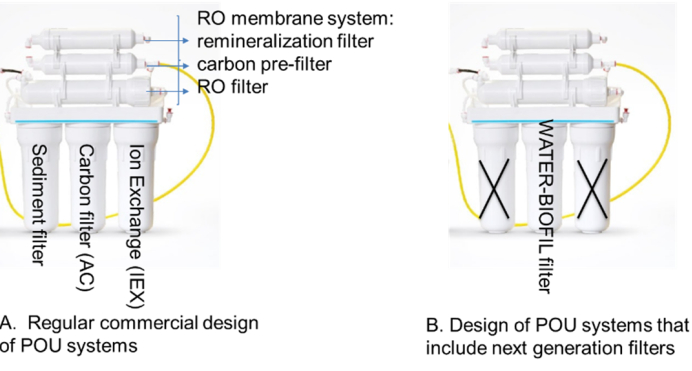
Thereby, the aim of WATER-BIOFIL project (https://icechim.ro/project/waterbiofil-en/) is to design & assemble & test next generation compostable filters, prepared from biodegradable polymers and/or bio-sourced polymers, which can be thereafter integrated in regular POU systems, and further serve their purpose as first-aid tools to cope with hydro-climatic extreme events, while diminishing the environmental impact of hazardous materials. In support to the WATER4ALL objectives targeting Water security, the main objective of WATER-BIOFIL targets the development of a 100% compostable - “3 in 1” pre-treatment filter for retaining organic, dyes, metal traces and dissolved salts that may extend the lifespan of RO membrane systems in POU, reducing the system to only 3 components vs. commercial ones.
With respect to the aim and objective of WATER-BIOFIL, in the first part of the project several results were achieved. Biodegradable filler materials, for retaining metal ion traces, dyes, organic residues, were first created by combining original preparation approaches and patented technologies for biopolymers obtaining, leading to know-how for adsorbents manufacturing. Further on, the first steps for creating the biodegradable cartridge prototype assumed preparation, characterization and testing - extrusion and 3D printing of several formulations based on poly(lactic acid).
The materials are adaptable for injection-molding technologies, as well. In parallel, several filter models were proposed and designed using a CAD software to fit the POU system and prototype filters were 3D printed using commercial PLA wire. Other important results obtained until mid-term refer to eco-friendly strategies for unclogging/recondition the fillers after use, biodegradability studies of the filler materials, and prototype filter testing in POU systems, as well as the assembly of a pilot distillation unit, to which the filter cartridge will be attached.
Together with these achievements, several OA studies and communications were released. In addition, participation to various science fairs and workshops have increased the visibility and impact of our project.